


Solutions: RNG Producers
Your RNG is under-realized.
The market is moving.
The infrastructure isn't.

Market Movement
The Market Is Moving in Two Directions at Once

The traditional compliance market is no longer expanding.
Fleet operators required to purchase RNG are already near full penetration. New production capacity is still coming online, but it’s competing for the same buyers.
As supply increases, differentiation determines who wins deals.
What used to be a captive market is now a competitive one.

At the same time, a large, unsaturated source of demand is emerging.
Data centers, industrial facilities, and corporate campuses are actively seeking low-carbon natural gas to meet Scope 3 targets, internal sustainability commitments, and investor expectations.
These buyers are not required to purchase.
They evaluate, compare, and choose based on what best fits their carbon strategy.
Today's infrastructure was built for compliance buyers.
Not for discretionary ones.
The market didn't just grow.
It changed how value is evaluated.
But the infrastructure behind RNG never evolved to match.
Structural Failure
Infrastructure Built for Yesterday’s Market
Most RNG infrastructure was designed for issuance and record-keeping.
Not for evaluation, discovery, or fast buyer decision-making.
Traditional registries work well at the moment a certificate is issued. After that point, the asset effectively stops evolving.
The result is infrastructure that functions like digital paper:
- Static
- Registry-bound
- Detached from how gas actually moves
- Unable to adapt to buyer-specific context
Why This Breaks Down Now
RNG moves through a network.
Its emissions profile changes with routing and destination.
But certificates don’t move with the gas & that creates two structural failures:
Incomplete emissions context
Production carbon intensity is captured at issuance. Transport emissions — critical for buyer evaluation — are not dynamically tracked as gas moves through the pipeline network.
When buyers ask:
“What are the emissions for delivery to my facility?”
The answer requires manual calculation, estimation, and reconstruction.
Invisibility to voluntary buyers
Static certificates were never designed to be discovered, compared, or evaluated outside their registry.
There is no native way for buyers to:
- Discover RNG inventory
- Compare attributes
- Evaluate delivery-specific emissions
- Move quickly from interest to transaction
Every interaction requires manual outreach, explanation, and data assembly.

When value depends on speed, visibility, and buyer-specific context, static certificates become a structural bottleneck.
The Solution
Your Difference Is Now Visible and Valuable
With Greentruth, your RNG can compete on its carbon intensity.
It’s discoverable and comparable across the platform, so buyers can evaluate it against their carbon strategy.
Transport emissions reflect actual delivery, so value isn’t flattened into averages.
That data holds up, verifiable and auditable across the entire value chain.
What this enables:
- Your RNG becomes visible to buyers beyond compliance markets
- Your carbon intensity becomes a differentiator
- Buyers evaluate your supply using delivery-specific emissions—not averages that depress its value
- Deals move faster, without manual outreach and explanation, not just reporting
- Your data supports pricing, not just reporting
Once your RNG enters the pipeline, it becomes physically indistinguishable from other molecules.
What differentiates your supply is its carbon intensity—but historically, that information doesn’t move with the gas. It gets separated, flattened, or lost as it moves through the system.
Greentruth changes that.
QET® Quantified Emissions Tokens
Your carbon intensity is encoded into QETs on the EarnDLT® blockchain—structured in a standardized, machine-readable schema aligned with the GHG Protocol and SBTi to create a verifiable, interoperable data asset across systems.
Learn more about QETs and EarnDLT >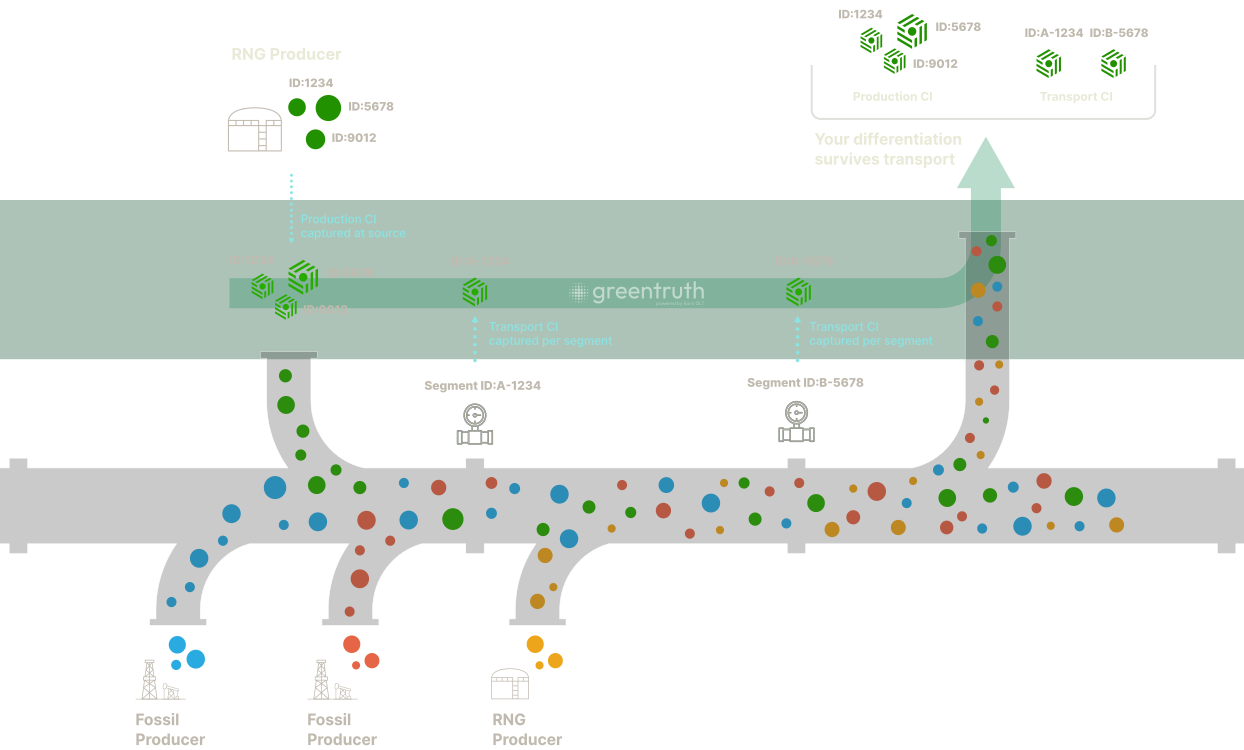
Verification, Simplified
Verification determines whether your RNG can be used and accounted for without inflating Scope 1 emissions.
Only production tied to verified delivery qualifies. If it doesn’t, it gets counted regardless of how it was produced.
In Greentruth, verification is built into the system,
so your production arrives already qualified.
Nothing to reconstruct.
Built on a modeled network of pipeline segments across the Lower 48, Greentruth validates all five delivery criteria required to prove physical delivery via common carrier pipelines.
This enables verified transactions across the contiguous U.S.—something legacy registries cannot fully support.
32K+
Pipeline segments mapped to calculate transport emissions from production to delivery
Greentruth automatically calculates ISO verified emissions based on actual routing and destination, eliminating error-prone manual calculations and removing reliance on GREET-style averages.

How It’s Proven
Verification is enforced through a structured, multi-point validation process embedded in each QET-RNG.
- Injection point verified
- Delivery point confirmed
- Pipeline connectivity established
- Volume matched
- Timing aligned to reporting periods
Only production that meets all five criteria allows buyers to exclude emissions from Scope 1 totals.
Next Steps
See How Carbon Intensity
Becomes Your Market Advantage
Create a free account to explore Greentruth and see how
the carbon intensity of RNG shows up in the market.
No risk. No cost. No obligation.