


Solutions: RNG Buyers
From comparison to accounting, your RNG strategy
requires infrastructure.
Greentruth makes it count.

Strategic Opportunity
The Execution Question
RNG has earned its place in your carbon strategy. The question is whether you can execute that strategy.
Evaluate with precision?
- Identify RNG that matches your carbon strategy?
- Compare producers and evaluate routing impact?
- See carbon intensity that reflects real-world supply — not generic averages?
Transact without friction?
- Move from evaluation to transaction without manual outreach and email chains?
- Can emissions data flow directly into your existing systems without manual input or reconstruction?
Account under scrutiny?
- Does the data come structured for use within your reporting framework?
- Is your RNG treated as an environmental attribute under GHGP — or as undifferentiated fossil gas?
- Is your RNG documentation auditable end to end?
These are not abstract considerations. They are the difference between a carbon strategy and a carbon claim.
GHGP defines how RNG purchases translate into your reported emissions. Without alignment, reductions go uncredited. Without structured documentation, targets can't be verified, disclosures have gaps, and third-party assurance becomes a liability — whether you're aligned with SBTi, disclosing through CDP, or verifying against TCR.
The gap between your RNG strategy and your ability to execute it cleanly is no longer a process inconvenience. It’s exposure.
The RNG market has supply.
What it doesn't have is buyer infrastructure.
The systems that exist today were built for a different purpose — issuance, record-keeping, compliance tracking.
They were designed to serve producers and registries, not buyers evaluating options, comparing carbon intensity, or translating procurement into defensible accounting.
Infrastructure Gap
Infrastructure Not Built for Buyers
No discovery layer
RNG inventory isn't visible.
There is no structured discovery and comparison layer for buyers to evaluate RNG supply across producers. Procurement relies on manual outreach, bilateral conversations, and data assembled from disconnected sources.
Carbon intensity information is static and presented in inconsistent formats. Without a unified comparison environment, buyers lack clear, side-by-side visibility into how supply options differ and what those differences mean for procurement decisions.
Emissions frozen
at production
Carbon intensity is captured at issuance and does not move with the gas. Transport emissions vary based on routing and destination but are not dynamically recalculated. The figure on the certificate reflects where the RNG was produced — not its full carbon profile in use.
Legacy certificates are built for
record-keeping, not buyer action.

The Cost of Misaligned Infrastructure
Extra Work,
Higher Risk
When emissions data doesn't flow automatically, your team fills the gap with spreadsheets and reconstructed calculations. Every manual step introduces inconsistency — and every inconsistency is a liability.
Higher Reported
Carbon Footprint
Without delivery-specific emissions, accounting defaults to production averages. The result doesn't reflect your actual procurement — and leaves real reductions unclaimed.
Benefits Paid for
but Unclaimed
Without structured chain-of-custody and GHGP-aligned documentation, that value doesn't translate into defensible accounting treatment. You've paid for it. You can't fully use it.
Same molecule. Different accounting.
Real economic difference.
The Solution
Making RNG Count
from Strategy to Disclosure
Greentruth closes the infrastructure gap between procurement and disclosure connecting discovery, delivery-specific emissions, and framework-aligned reporting in one governed system.
Greentruth is the buyer marketplace built on the EarnDLT registry bringing registry-grade governance to procurement and disclosure.
Where traditional certificates are static records, Greentruth issues and governs QETs (Quantified Emissions Tokens), machine-readable data assets that carry verified emissions information, move with RNG through the pipeline network, and are structured for use inside your reporting framework.
With Greentruth, you can:
- Discover available RNG inventory across producers that match your carbon strategy
- Compare carbon intensity across producers and delivery routes
- Find and purchase QETs tied to your RNG procurement based on delivery location
- Buy thermal certificates to lower your carbon impact
- Retire QETs in your organization's name
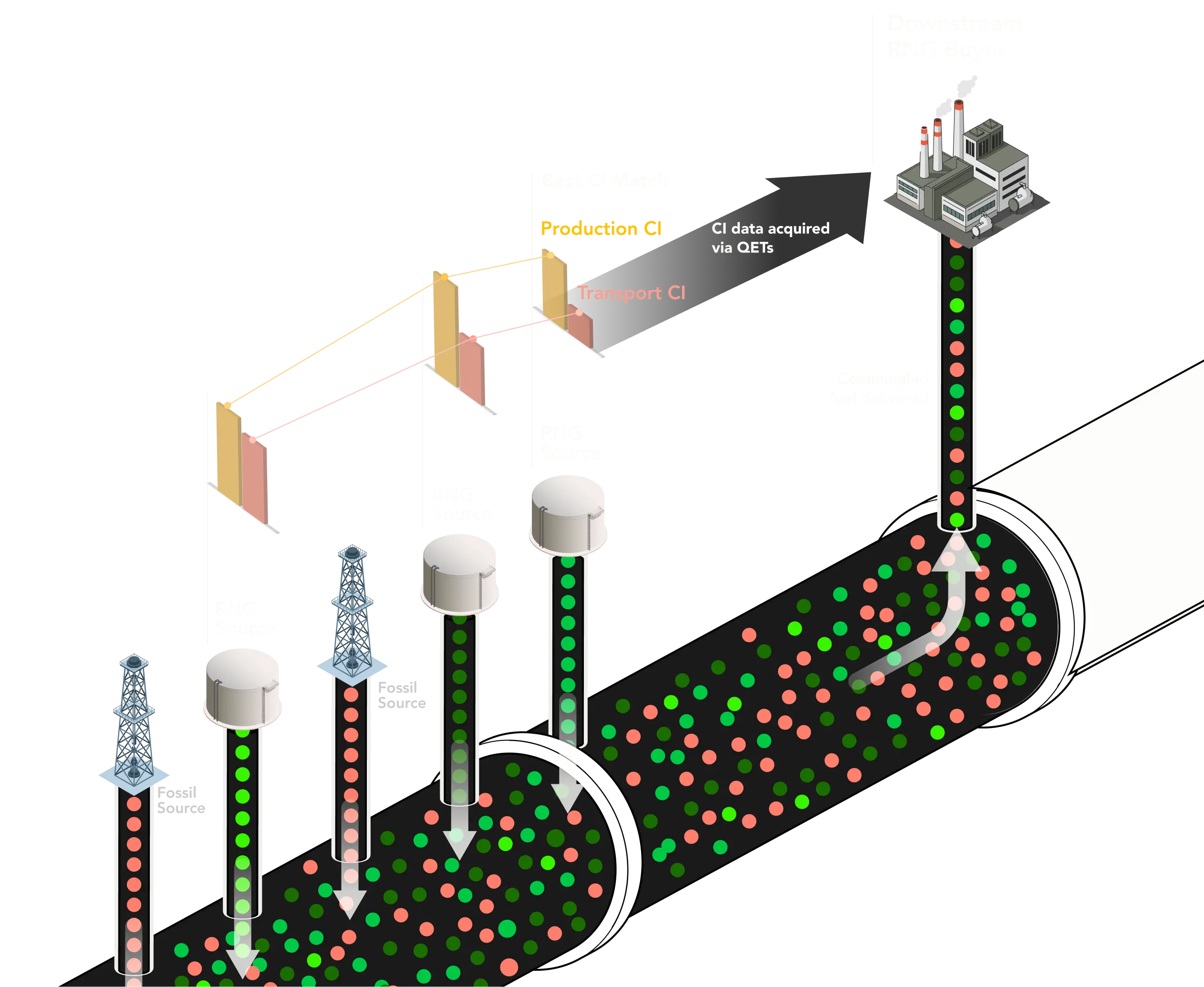
The Communal Punch Bowl
Once RNG enters the pipeline, it becomes indistinguishable from other molecules. What differentiates supply is the carbon intensity of its production and transport.
Greentruth tracks those attributes in Quantified Emissions Tokens (QETs), allowing buyers to compare carbon intensity across producers and acquire verified emissions data with their procurement.
Accounting, Resolved
In Greentruth, each delivery is already verified—and structured for reporting across SBTi, CDP, and TCR frameworks.
Biogenic CO₂ is properly separated and excluded from Scope 1 totals—aligned with GHG Protocol from the start.
What you purchase holds under audit.
Nothing to reconstruct.
Nothing between purchase and disclosure.
Built-In Verification
Proof that used to be reconstructed manually is built directly into the QET-RNG.
A QET-RNG embeds verified data across production, transport pathway, delivery, and custody—capturing the full chain of evidence required for reporting, secured with cryptographic proof on EarnDLT.
In effect, it functions as a digital passport for environmental attributes—moving with the gas through the system.
Next Steps
Explore How Greentruth Maps
to Your Reporting Framework
We've prepared three guides to show exactly how Greentruth works within your reporting framework. Each one maps QET-RNG data directly to a specific framework — showing exactly how emissions reductions are calculated, which fields to populate, what documentation satisfies verification, and how disclosures should be structured.
Select the frameworks relevant to your organization when you fill out the request form.
- Using QET-RNG for SBTi Target Achievement
How RNG procurement counts toward near-term and long-term science-based targets, and what documentation ensures reductions are recognized. - CDP Reporting with QET-RNG Certificates
Question-by-question guidance for Scope 1, Scope 3, , including how QET-RNG data satisfies verification requirements. - TCR Reporting Checklist for QET-RNG
A structured checklist to ensure Climate Registry submissions reflect delivery-specific emissions and withstand verification.
Ready to explore Greentruth?
Register for a free account.
No risk. No cost.
No obligation.