Greentruth logo

Resources

Methodologies
Methodology cover

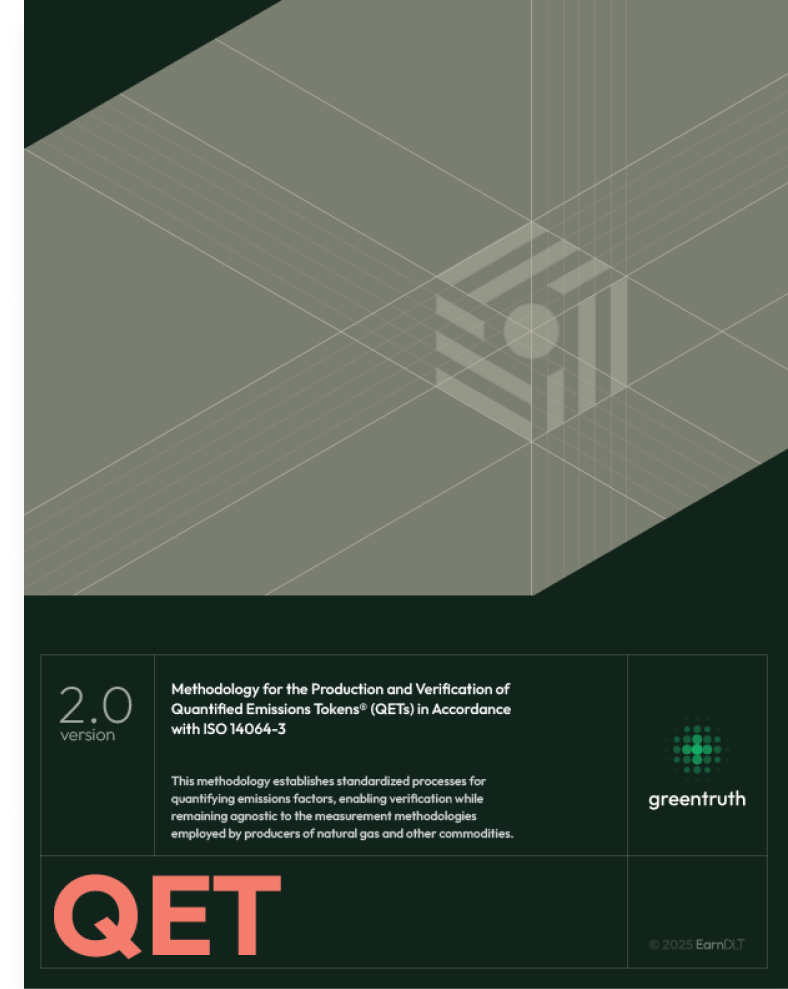
Methodology for the Production and Verification of Quantified Emissions Tokens® (QETs) in Accordance with ISO 14064-3

This methodology establishes standardized processes for quantifying emissions factors, enabling verification while remaining agnostic to the measurement methodologies employed by producers of natural gas and other commodities.
Preview this methodology >
Methodology cover

Methodology for the Production and Verification of Low Carbon Fuel Standard Quantified Emissions Tokens® (QET-LCFS) in Accordance with ISO 14064-3

This methodology defines procedures for producing and verifying QET-LCFS for California LCFS compliance, extending the core QET framework to incorporate LCFS-specific carbon intensity, fuel pathway, and CARB verification requirements.
Preview this methodology >
Methodology cover

Methodology for the Production and Verification of Ethanol Quantified Emissions Tokens® (QET-Ethanol) in Accordance with ISO 14064-3

This methodology extends the core QET framework to ethanol production, addressing process-specific characteristics including biological fermentation, synthetic production pathways, and diverse feedstock sources.
Preview this methodology >
Methodology cover

Methodology for the Production and Verification of Carbon Capture and Sequestration Quantified Emissions Tokens® (QET-CCS) — kgCO₂e Removed

This methodology defines a framework for QET-CCS, where each token represents 1 kgCO₂e permanently removed and immutably tracked via the EarnDLT registry.
Preview this methodology >
Methodology cover

Methodology for the Production and Verification of Solid Fuel Thermal Quantified Emissions Tokens (QET-SOL) — kgCO₂e/MMBtu

This methodology defines procedures for producing, quantifying, disclosing, and verifying QET-SOL.
Preview this methodology >
Methodology cover

Methodology for the Production and Verification of Renewable Natural Gas Quantified Emissions Token Thermal Certificates (QET-RNG) — kgCO₂e/MMBtu

This methodology defines QET-RNG Thermal Certificates, measuring GHG intensity in kgCO₂e/MMBtu.
Preview this methodology >
Greentruth logo

Document Preview

Limited preview available

Methodology for the Production and Verification of Quantified Emissions Tokens® (QETs) in Accordance with ISO 14064-3

This comprehensive methodology document outlines a verifiable framework for the production of Quantified Emissions Tokens® (QETs) that is aligned with ISO 14064-3 verification requirements. The methodology establishes standardized processes for quantifying emissions factors while remaining agnostic to specific measurement methodologies employed by producers of natural gas and other commodities.

Methodology cover

Introduction and Scope

This methodology is designed to be compatible with and verifiable under ISO 14064-3 standards for greenhouse-gas quantification and reporting, while incorporating the principles of ISO 14067 for product carbon footprinting. It establishes the requirements for QET production regardless of the specific measurement technology or approach used by the producer, so long as the measurement methodology meets the minimum requirements for data quality, uncertainty management, and verification.

The Quantified Emissions Token (QET) serves as a digital container for verified environmental attributes and emissions data from real-world commodities. This methodology document provides the procedural framework for creating, validating, and verifying QETs that represent the environmental impacts of physical commodities, with particular focus on natural gas production, processing, transmission, and distribution.

This document is compliant with ISO 14064-3 standards for greenhouse-gas verification and validation.

The information contained in this document is intended solely for authorized recipients and may be legally privileged. Any unauthorized review, use, disclosure, or distribution is prohibited. Nothing contained herein shall be construed as providing legal, financial, or technical advice. Earn DLT, Inc. makes no warranties, express or implied, regarding the accuracy, completeness, or fitness for a particular purpose of the information contained herein.

No part of this document may be reproduced, distributed to third parties, in whole or in part, without the express written permission of Earn DLT, Inc. The methodology described herein, including the Quantified Emissions Token® (QET) framework, is the intellectual property of Earn DLT, Inc. and is subject to patent and/or other intellectual property protections.

© 2025 Earn DLT, Inc. All rights reserved. This document contains proprietary and confidential information of Earn DLT, Inc. and is protected by copyright law. The Earn logo is a registered trademark of Earn DLT, Inc.

Contents

  1. 1. Introduction and Scope10
  2. 1. Key Objectives10
  3. 2. Normative References10
  4. 3. Terms and Definitions11
  5. 3.1 Quantified Emissions Token (QET)11
  6. 3.2 Methane Intensity (MI)11
  7. 3.3 GHG Pollutant Intensity11
  8. 3.4 Carbon Intensity (CI)11
  9. 3.5 Measurement, Reporting, and Verification (MRV)11
  10. 3.6 Primary Data12
  11. 3.7 Secondary Data12
  12. 3.8 Uncertainty12
  13. 3.9 Global Warming Potential (GWP)12
  14. 3.10 Path-Based Emissions12
  15. 3.11 Segment Allocation Factor12
  16. 3.12 Pipeline and Hazardous Materials Safety Administration (PHMSA)12
  17. 3.13 Delivery Location (DLVRY LOC)13
  18. 3.14 Receipt Location (RCPT LOC)13
  19. 3.15 Natural Gas Processing13
  20. 3.16 Processing Plant Boundary13
  21. 3.17 Natural Gas Liquids (NGL) Allocation13
  22. 3.18 Processing Efficiency Factor13
  23. 3.19 EU Methane Regulation (EUMR)13
  24. 3.20 Production-Level Reporting13
  25. 3.21 Reasonable Assurance for EU Compliance14
  26. 4. General Requirements for QET Production14
  27. 4.1 Principles14
  28. 4.2 Impartiality14
  29. 4.3 Evidence-based Approach15
  30. 4.4 System Boundaries16
  31. 4.4.1 Boundary Definition16
  32. 4.4.2 Included Activities16
  33. 4.4.3 Emission Sources17
  34. 5. Quantification Methodology for QET Production17
  35. 5.1 Emissions Data Acquisition18
  36. 5.1.1 Data Requirements18
  37. 5.1.2 Data Hierarchy18
  38. 5.1.3 Minimum Detection Limits and Measurement Frequency18
  39. 5.2 Methane Intensity Calculation18
  40. 5.2.1 QET Pollutant Intensity Calculation18

Continue Reading

You've reached the end of the preview.

Create an account or log in to access the full methodology document.

Download the full methodology document below.

Greentruth logo

Document Preview

Limited preview available

Methodology for the Production and Verification of Low Carbon Fuel Standard Quantified Emissions Tokens® (QET-LCFS) in Accordance with ISO 14064-3

This methodology defines procedures for producing and verifying QET-LCFS for California LCFS compliance, extending the core QET framework to incorporate LCFS-specific carbon intensity, fuel pathway, and CARB verification requirements.

Methodology cover

Introduction and Scope

The QET-LCFS methodology establishes a comprehensive framework for producing verified emissions tokens that meet California's Low Carbon Fuel Standard (LCFS) requirements. This methodology extends the core QET framework while incorporating specific requirements for carbon intensity calculation, fuel pathway certification, and CARB verification processes.

This document provides the procedures necessary for tracking and verifying the carbon intensity of transportation fuels throughout their lifecycle, ensuring compliance with California Air Resources Board (CARB) regulations while maintaining compatibility with ISO 14064-3 verification standards.

This document is compliant with ISO 14064-3 standards for greenhouse-gas verification and validation.

The information contained in this document is intended solely for authorized recipients and may be legally privileged. Any unauthorized review, use, disclosure, or distribution is prohibited. Nothing contained herein shall be construed as providing legal, financial, or technical advice. Earn DLT, Inc. makes no warranties, express or implied, regarding the accuracy, completeness, or fitness for a particular purpose of the information contained herein.

No part of this document may be reproduced, distributed to third parties, in whole or in part, without the express written permission of Earn DLT, Inc. The methodology described herein, including the Quantified Emissions Token® (QET) framework, is the intellectual property of Earn DLT, Inc. and is subject to patent and/or other intellectual property protections.

© 2025 Earn DLT, Inc. All rights reserved. This document contains proprietary and confidential information of Earn DLT, Inc. and is protected by copyright law. The Earn logo is a registered trademark of Earn DLT, Inc.

Contents

  1. 1. Key Objectives10
  2. 2. Normative References10
  3. 3. Terms and Definitions11
  4. 3.1 Low Carbon Fuel Standard (LCFS)11
  5. 3.2 Carbon Intensity (CI)11
  6. 3.3 Fuel Pathway11
  7. 3.4 CARB Verification12
  8. 3.5 Lifecycle Analysis12
  9. 4. LCFS-Specific Requirements13
  10. 4.1 Pathway Certification13
  11. 4.2 CI Calculation Methods14
  12. 4.3 Verification Requirements15
  13. 5. QET-LCFS Production16
  14. 5.1 Data Collection16
  15. 5.2 CI Determination17
  16. 5.3 Token Generation18

Continue Reading

You've reached the end of the preview.

Create an account or log in to access the full methodology document.

Download the full methodology document below.

Greentruth logo

Document Preview

Limited preview available

Methodology for the Production and Verification of Ethanol Quantified Emissions Tokens® (QET-Ethanol) in Accordance with ISO 14064-3

This methodology extends the core QET framework to ethanol production, addressing process-specific characteristics including biological fermentation, synthetic production pathways, and diverse feedstock sources.

Methodology cover

Introduction and Scope

The QET-Ethanol methodology provides a specialized framework for quantifying and verifying emissions associated with ethanol production. This methodology addresses the unique characteristics of ethanol manufacturing, including biological fermentation processes, diverse feedstock options, and both conventional and advanced production pathways.

This document establishes requirements for tracking emissions throughout the ethanol production lifecycle, from feedstock cultivation and processing through fermentation, distillation, and distribution, while maintaining compliance with ISO 14064-3 verification standards.

This document is compliant with ISO 14064-3 standards for greenhouse-gas verification and validation.

The information contained in this document is intended solely for authorized recipients and may be legally privileged. Any unauthorized review, use, disclosure, or distribution is prohibited. Nothing contained herein shall be construed as providing legal, financial, or technical advice. Earn DLT, Inc. makes no warranties, express or implied, regarding the accuracy, completeness, or fitness for a particular purpose of the information contained herein.

No part of this document may be reproduced, distributed to third parties, in whole or in part, without the express written permission of Earn DLT, Inc. The methodology described herein, including the Quantified Emissions Token® (QET) framework, is the intellectual property of Earn DLT, Inc. and is subject to patent and/or other intellectual property protections.

© 2025 Earn DLT, Inc. All rights reserved. This document contains proprietary and confidential information of Earn DLT, Inc. and is protected by copyright law. The Earn logo is a registered trademark of Earn DLT, Inc.

Contents

  1. 1. Key Objectives10
  2. 2. Normative References10
  3. 3. Terms and Definitions11
  4. 3.1 Ethanol Production Pathways11
  5. 3.2 Feedstock Categories11
  6. 3.3 Fermentation Emissions12
  7. 3.4 Co-product Allocation12
  8. 4. Ethanol-Specific Requirements13
  9. 4.1 Feedstock Characterization13
  10. 4.2 Process Emissions14
  11. 4.3 Co-product Treatment15
  12. 5. QET-Ethanol Production16
  13. 5.1 Boundary Definition16
  14. 5.2 Emissions Quantification17
  15. 5.3 Verification Process18

Continue Reading

You've reached the end of the preview.

Create an account or log in to access the full methodology document.

Download the full methodology document below.

Greentruth logo

Document Preview

Limited preview available

Methodology for the Production and Verification of Carbon Capture and Sequestration Quantified Emissions Tokens® (QET-CCS) — kgCO₂e Removed

This methodology extends the core QET framework to ethanol production, addressing process-specific characteristics including biological fermentation, synthetic production pathways, and diverse feedstock sources.

Methodology cover

Introduction and Scope

The QET-CCS methodology establishes a comprehensive framework for quantifying, verifying, and tokenizing carbon dioxide removal through capture and sequestration technologies. Each QET-CCS token represents one kilogram of CO₂ equivalent permanently removed from the atmosphere and securely stored in geological formations.

This methodology addresses the complete CCS value chain, from carbon capture at emission sources through transportation and injection into geological storage sites, ensuring permanent sequestration and providing immutable verification through the EarnDLT registry system.

This document is compliant with ISO 14064-3 standards for greenhouse-gas verification and validation.

The information contained in this document is intended solely for authorized recipients and may be legally privileged. Any unauthorized review, use, disclosure, or distribution is prohibited. Nothing contained herein shall be construed as providing legal, financial, or technical advice. Earn DLT, Inc. makes no warranties, express or implied, regarding the accuracy, completeness, or fitness for a particular purpose of the information contained herein.

No part of this document may be reproduced, distributed to third parties, in whole or in part, without the express written permission of Earn DLT, Inc. The methodology described herein, including the Quantified Emissions Token® (QET) framework, is the intellectual property of Earn DLT, Inc. and is subject to patent and/or other intellectual property protections.

© 2025 Earn DLT, Inc. All rights reserved. This document contains proprietary and confidential information of Earn DLT, Inc. and is protected by copyright law. The Earn logo is a registered trademark of Earn DLT, Inc.

Contents

  1. 1. Key Objectives10
  2. 2. Normative References10
  3. 3. Terms and Definitions11
  4. 3.1 Carbon Capture11
  5. 3.2 Geological Sequestration11
  6. 3.3 Permanence12
  7. 3.4 Monitoring and Verification12
  8. 4. CCS-Specific Requirements13
  9. 4.1 Capture Technology13
  10. 4.2 Storage Site Characterization14
  11. 4.3 Long-term Monitoring15
  12. 5. QET-CCS Production16
  13. 5.1 Capture Quantification16
  14. 5.2 Injection Verification17
  15. 5.3 Registry Integration18

Continue Reading

You've reached the end of the preview.

Create an account or log in to access the full methodology document.

Download the full methodology document below.

Greentruth logo

Document Preview

Limited preview available

Methodology for the Production and Verification of Solid Fuel Thermal Quantified Emissions Tokens (QET-SOL) — kgCO₂e/MMBtu

This methodology defines procedures for producing, quantifying, disclosing, and verifying QET-SOL, with GHG intensity standardized to kgCO₂e/MMBtu. It enables QET-SOL to function as audit-ready environmental attribute certificates aligned with ISO 14064-3 and referencing the EarnDLT QET core methodology.

Methodology cover

Introduction and Scope

The QET-SOL methodology provides a standardized framework for quantifying and verifying greenhouse gas emissions associated with solid fuel production and combustion. This methodology establishes procedures for measuring GHG intensity in units of kgCO₂e per million British thermal units (MMBtu), enabling transparent tracking of solid fuel environmental performance.

This document addresses the complete lifecycle of solid fuels, including extraction, processing, transportation, and end-use combustion, while providing mechanisms for environmental attribute certification that meet ISO 14064-3 verification standards.

This document is compliant with ISO 14064-3 standards for greenhouse-gas verification and validation.

The information contained in this document is intended solely for authorized recipients and may be legally privileged. Any unauthorized review, use, disclosure, or distribution is prohibited. Nothing contained herein shall be construed as providing legal, financial, or technical advice. Earn DLT, Inc. makes no warranties, express or implied, regarding the accuracy, completeness, or fitness for a particular purpose of the information contained herein.

No part of this document may be reproduced, distributed to third parties, in whole or in part, without the express written permission of Earn DLT, Inc. The methodology described herein, including the Quantified Emissions Token® (QET) framework, is the intellectual property of Earn DLT, Inc. and is subject to patent and/or other intellectual property protections.

© 2025 Earn DLT, Inc. All rights reserved. This document contains proprietary and confidential information of Earn DLT, Inc. and is protected by copyright law. The Earn logo is a registered trademark of Earn DLT, Inc.

Contents

  1. 1. Key Objectives10
  2. 2. Normative References10
  3. 3. Terms and Definitions11
  4. 3.1 Solid Fuel Categories11
  5. 3.2 Thermal Content11
  6. 3.3 Combustion Emissions12
  7. 3.4 Lifecycle Boundaries12
  8. 4. SOL-Specific Requirements13
  9. 4.1 Fuel Characterization13
  10. 4.2 Intensity Calculation14
  11. 4.3 Quality Assurance15
  12. 5. QET-SOL Production16
  13. 5.1 Data Collection16
  14. 5.2 Emissions Accounting17
  15. 5.3 Token Issuance18

Continue Reading

You've reached the end of the preview.

Create an account or log in to access the full methodology document.

Download the full methodology document below.

Greentruth logo

Document Preview

Limited preview available

Methodology for the Production and Verification of Renewable Natural Gas Quantified Emissions Token Thermal Certificates (QET-RNG) — kgCO₂e/MMBtu

This methodology defines QET-RNG Thermal Certificates, measuring GHG intensity in kgCO₂e/MMBtu, with each token representing 1 MMBtu of verified renewable natural gas. Tokens are issued and tracked through the EarnDLT registry, providing immutable records and transparent chain-of-custody.

Methodology cover

Introduction and Scope

The QET-RNG methodology establishes a comprehensive framework for quantifying, verifying, and certifying renewable natural gas production. This methodology addresses the unique characteristics of RNG production from various feedstocks including agricultural waste, landfill gas, wastewater treatment facilities, and other organic sources.

Each QET-RNG token represents one million British thermal units (MMBtu) of verified renewable natural gas, with associated greenhouse gas intensity measured in kgCO₂e/MMBtu. This methodology ensures transparent tracking of environmental attributes while maintaining compatibility with existing renewable fuel standards and ISO 14064-3 verification requirements.

This document is compliant with ISO 14064-3 standards for greenhouse-gas verification and validation.

The information contained in this document is intended solely for authorized recipients and may be legally privileged. Any unauthorized review, use, disclosure, or distribution is prohibited. Nothing contained herein shall be construed as providing legal, financial, or technical advice. Earn DLT, Inc. makes no warranties, express or implied, regarding the accuracy, completeness, or fitness for a particular purpose of the information contained herein.

No part of this document may be reproduced, distributed to third parties, in whole or in part, without the express written permission of Earn DLT, Inc. The methodology described herein, including the Quantified Emissions Token® (QET) framework, is the intellectual property of Earn DLT, Inc. and is subject to patent and/or other intellectual property protections.

© 2025 Earn DLT, Inc. All rights reserved. This document contains proprietary and confidential information of Earn DLT, Inc. and is protected by copyright law. The Earn logo is a registered trademark of Earn DLT, Inc.

Contents

  1. 1. Key Objectives10
  2. 2. Normative References10
  3. 3. Terms and Definitions11
  4. 3.1 Renewable Natural Gas11
  5. 3.2 Feedstock Categories11
  6. 3.3 Upgrading Processes12
  7. 3.4 Pipeline Quality Standards12
  8. 4. RNG-Specific Requirements13
  9. 4.1 Feedstock Qualification13
  10. 4.2 Production Pathway14
  11. 4.3 Environmental Attributes15
  12. 5. QET-RNG Production16
  13. 5.1 Biogas Quantification16
  14. 5.2 Upgrading Verification17
  15. 5.3 Certificate Generation18

Continue Reading

You've reached the end of the preview.

Create an account or log in to access the full methodology document.

Download the full methodology document below.